
Frustration with the slow pace of progress in the cleanup of the former Grumman superfund site in Calverton has residents and government officials fed up.

Long Island waters are threatened by runoff from hundreds of thousands of cesspools, harmful algae and even flesh-eating bacteria, but opportunities for cleanup are "unprecedented," a prominent ecologist will tell residents, advocates and elected officials in an address Friday.
Stony Brook University Professor Christopher Gobler, whose laboratory monitors water quality across the region, will host the annual State of the Bays symposium at the Stony Brook Southampton Avram Theater on Friday at 7 p.m. He gave a preview at a news conference Tuesday in Riverhead.

Due to widespread use of PFAS “forever chemicals” in numerous products and industries, PFAS has become ubiquitous in our environment, including our drinking water. As a result, PFAS is now detected in the blood of 98% of Americans. That’s a major concern, since PFAS exposure is linked to serious health conditions, including cancer and adverse developmental impacts in children.
The NYS Senate has passed two bills, with strong bipartisan support, that would move toward a comprehensive solution. Now we need the NYS Assembly to pass both bills before session ends on June 4th. The two bills would:
✔ Protect our drinking water from the contamination that’s already occurred: Scientific studies have made clear that there is no safe level of PFAS in drinking water, but yet, it is being detected in the drinking water of millions of New Yorkers. Legislation would require water suppliers to strictly limit 5 PFAS chemicals often found in drinking water. While the EPA had adopted regulations in 2024 to limit these chemicals in drinking water nationwide, the Trump EPA recently announced rules to delay and roll them back. New York State must step up to protect our health just as Maine, Vermont, and Wisconsin have already done.
✔ Prevent further PFAS contamination by banning it in consumer products: We’ll never truly address the PFAS crisis if we continue to use these chemicals in new consumer products. Legislation will turn off the tap to more PFAS in our environment by banning it in products we use every day, including cookware, dental floss, textiles, rugs, cleaning products, and more.
Email the Speaker of the NYS Assembly today and urge him to allow both bills to receive a floor vote before the end of session. If you have an extra minute, call his office at 518-455-3791 and urge the Assembly to pass the Ban on PFAS in Consumer Products (A.7738A) and PFAS Drinking Water Protection bill (A.8634B).
Thank you for taking action!
Sincerely,
All of Us at CCE
Earth Day is not what it used to be, in amazing and terrible ways.
The South Fork Wind project is marking its first full year of operation, and new data released this week shows the nation’s first utility‑scale offshore wind farm is performing even better than expected. Leaders from LIPA, labor unions, environmental groups and the offshore wind industry gathered on Long Island to highlight the results, which show the 12‑turbine project generated electricity on 99% of days last year and reached a 50% capacity factor—a level comparable to traditional power plants during key demand periods.
The Town of Brookhaven held a public meeting on March 27 to present its corrective measures plan for a toxic plume emanating from the town landfill in Yaphank, but community advocates say the proposal falls far short of what’s needed.
In 2023, the New York State Department of Environmental Conservation ordered the town to investigate and plan to remediate the plume, which now extends 1.7 miles from the portions of the landfill constructed between 1971 and 1989 south toward Bellport Bay. Groundwater testing detected PFAS (so-called “forever chemicals”) and 1,4-dioxane in the plume. Both contaminants have been linked to a range of health issues, including cancer.
It was the first week of spring and Deborah Harris, of Riverhead, was visiting her local garden center, where she picked up two bags of fertilizer that she was told worked like a charm to keep deer off her hosta plants.
But after being advised to read the label for the product, Harris discovered the origins of the product were a sewage treatment facility in the Midwest, including the disclosure that it contained biosolids, one of the byproducts of waste treatment.
The Blueprint:
The Long Island Lobby Coalition requested over $1 billion in funding from Albany to address regional needs.
The coalition includes small business owners, civic leaders, labor, environmental groups, and transportation advocates.
Funding requests include support for chambers of commerce, wastewater, solar power, affordable housing, and transportation improvements.
The coalition met with bipartisan state senators, assembly members, and Governor Hochul’s policy team.
Off the coast of Long Island, a new chapter in the region’s energy future is already spinning.
The South Fork Wind project — the first utility-scale offshore wind farm serving New York — is now delivering electricity to the East End, demonstrating that offshore wind is no longer theoretical. It’s operating infrastructure.
WASHINGTON — President Donald Trump’s strikes on Iran and ensuing oil price increases are reigniting a debate over the wisdom of ramping up domestic oil drilling while deemphasizing renewable energy sources.
Clean energy advocates say the conflict in Iran — which has increased oil prices by 40% globally since the United States and Israel launched a joint strike on Feb. 28, according to industry monitor GasBuddy — underscores the need to reduce the country’s reliance on oil and gas by investing in renewable energy sources. But Trump and Department of Energy officials maintain that the strikes on Iran will be short-lived and energy prices will quickly stabilize.
In a virtual presentation on March 6, environmental scientists and advocates broke down how long-lasting per- and polyfluoroalkyl substances have infiltrated Long Island produce. Citizens Campaign for the Environment Executive Director Adrienne Esposito along with other experts arranged a study focusing on how these “forever chemicals” impact Long Island farmland.

Help CCE build on our success, and support our campaigns to protect public health and the environment in NY and CT.
Make a contribution today.
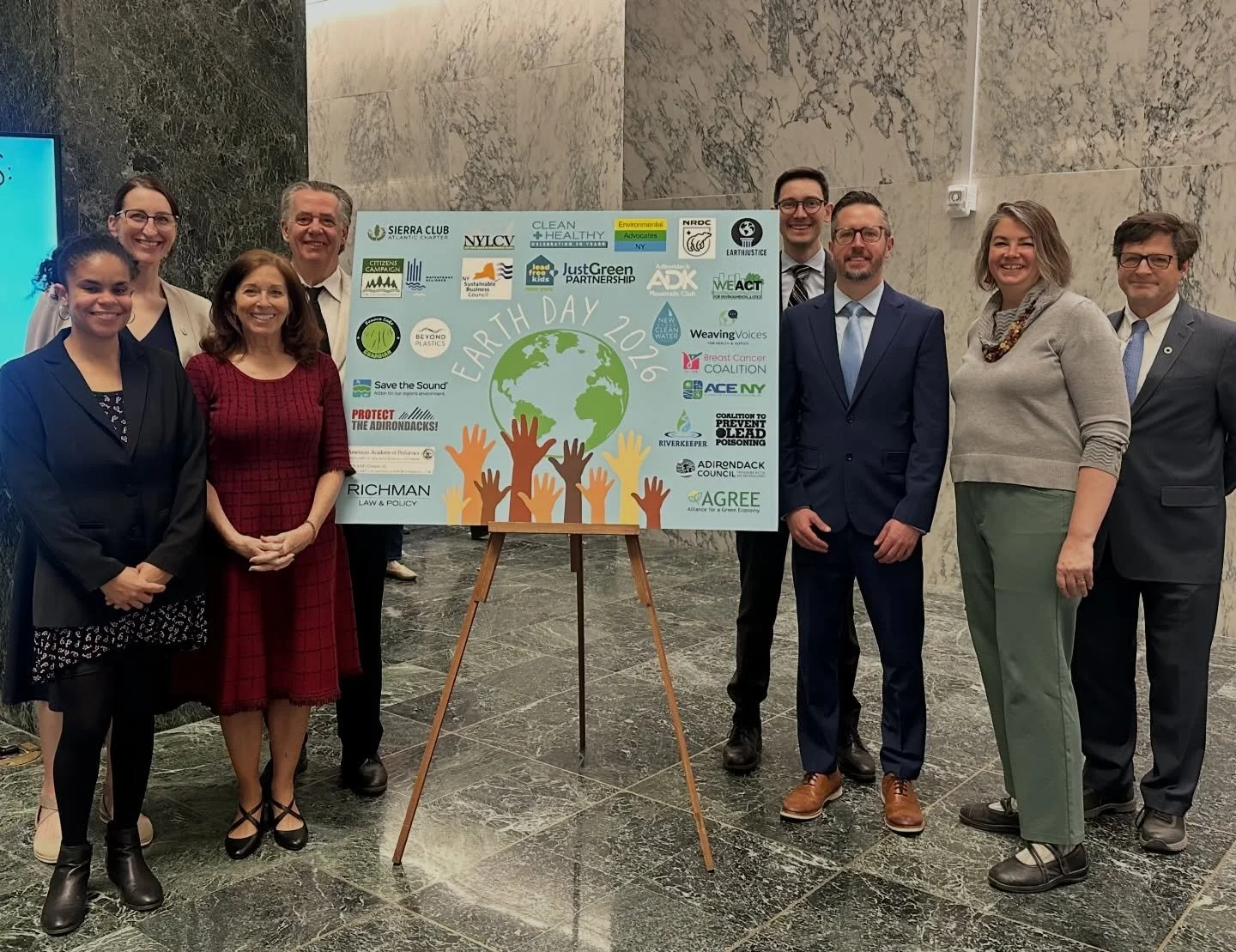
Earth Day Advocacy Day in Albany
We headed to Albany for the annual Earth Day Advocacy Day, where we joined our environmental partners to advocate for priority bills to protect our air, water, and health. This year, we pushed for:
The Packaging Reduction and Recycling Infrastructure Act, which requires product manufacturers—not taxpayers—to be responsible for the cost of collecting and recycling the packaging waste they create. If passed into law, this legislation will reduce packaging waste, increase recycling, eliminate toxic chemicals in packaging, reduce greenhouse gas emissions, and save local governments across the state hundreds of millions of dollars annually!
Banning the use of PFAS chemicals in a host of everyday products—textile articles, rugs, fabric treatments, cookware, ski waxes, dental floss, and cleaning products. This legislation has passed the NY Senate but still needs to pass the Assembly. Email your NYS Assemblymember and Assembly Speaker Carl Heastie today and urge them to pass this important legislation!
The Accelerate Solar for Affordable Power (ASAP) Act, which would significantly increase NY’s goal for distributed solar power (rooftop and community solar). This would create more clean energy and save ratepayers $1 billion annually when implemented.
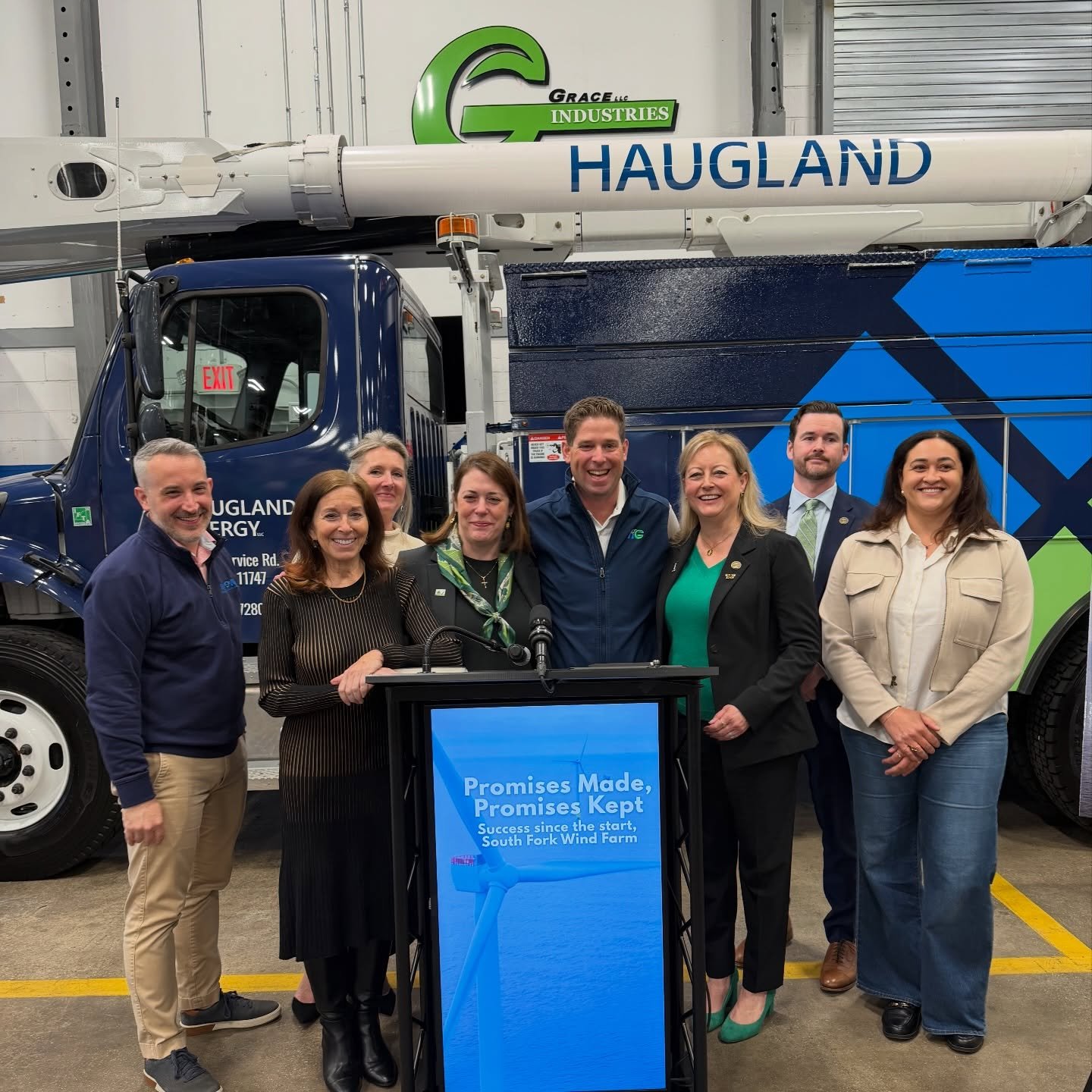
South Fork Wind: Promises Made, Promises Kept
We joined our environmental partners, labor leaders, and LIPA to kick off Earth Week by celebrating the success of the South Fork Wind Farm. This is the first utility scale offshore wind farm in America, powering 70,000 homes with clean energy. The wind farm exceeded expectations over the past year, generating clean, safe power 99% of the days. South Fork Wind proved it could help stabilize the grid when energy prices spiked as Summer and Winter energy demand rose, outpacing fossil fuel pricing and saving us money on our energy bills. It’s also created thousands of union jobs, helping to support the local economy. To learn more, watch the press conference here.
U.S. House Passes Bill to Advance Great Lakes and Long Island Sound Protection
The U.S House has passed the American Water Stewardship Act (H.R 6422), which included reauthorization of priority programs including the Long Island Sound Partnership and Great Lakes Restoration Initiative! These programs provide crucial funding to protect and restore our waterways. This bill now moves to the Senate for consideration. New York and Connecticut residents: we encourage you to call your U.S. Senators to urge them to support these key programs!
Fighting to Clean Up the Calverton Navy Plume
For decades, there has been growing concern about toxic plumes originating from the former Navy/Gruman facility in Calverton discharging into Long Island’s sole-source aquifer and local waterways, resulting in fish consumption warnings and groundwater pollution. Continued delays by the Navy have fueled frustration for residents, advocates and county officials who fear the growing health risks associated with our drinking water and surface water bodies. We joined Suffolk County Executive Romaine and the Calverton Restoration Advisory Board (RAB) to hear new data from the Suffolk County Health Department on ground and surface water contamination. We will continue to push the Navy to take action and protect the public from this toxic plume.
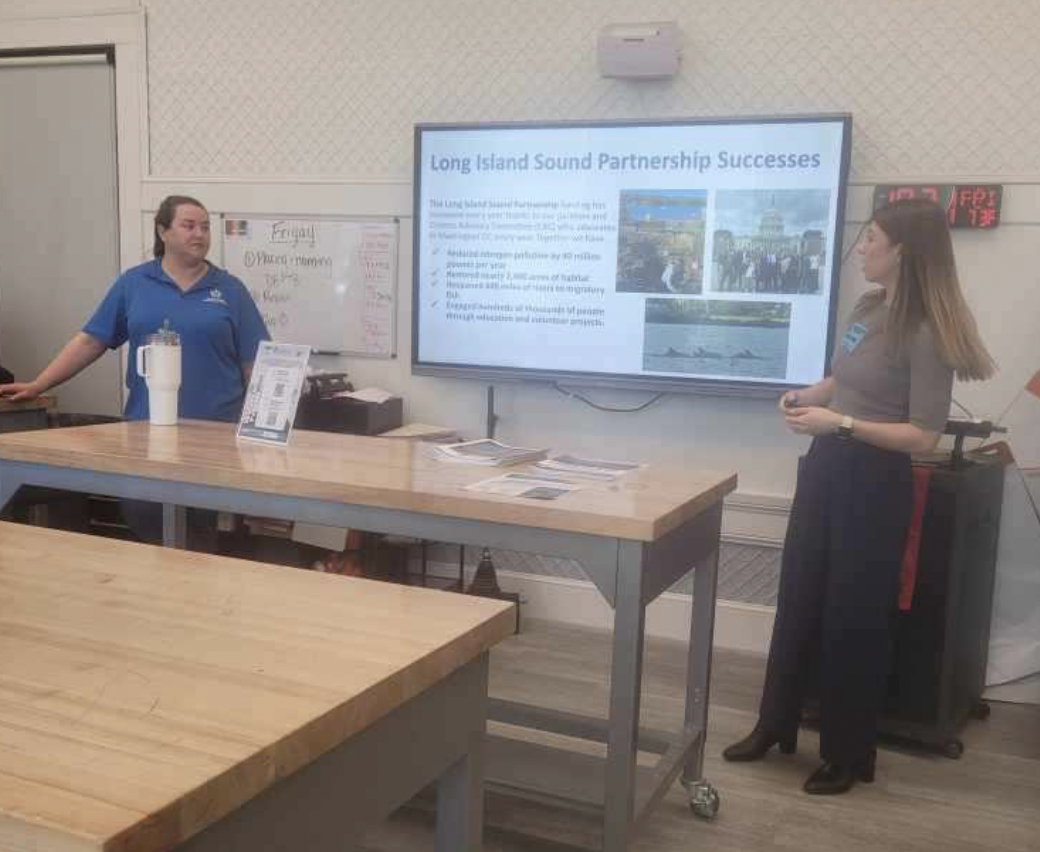
Gearing Up for the Long Island Sound High School Summit
We joined our partners at Atlantic Marine Conservation Society and Friends of the Bay on visits to several high schools to educate students on the importance of protecting the Long Island Sound. We spoke about our ongoing restoration efforts through the Long Island Sound Partnership and our current challenges such as nitrogen loading, habitat destruction, invasive species, climate change and plastic pollution. As part of our upcoming LI Sound High School Summit, students will prepare a project related to protection and restoration of the Sound and then participate in an educational field trip to The WaterFront Center in May to experience hands-on learning about the Sound.
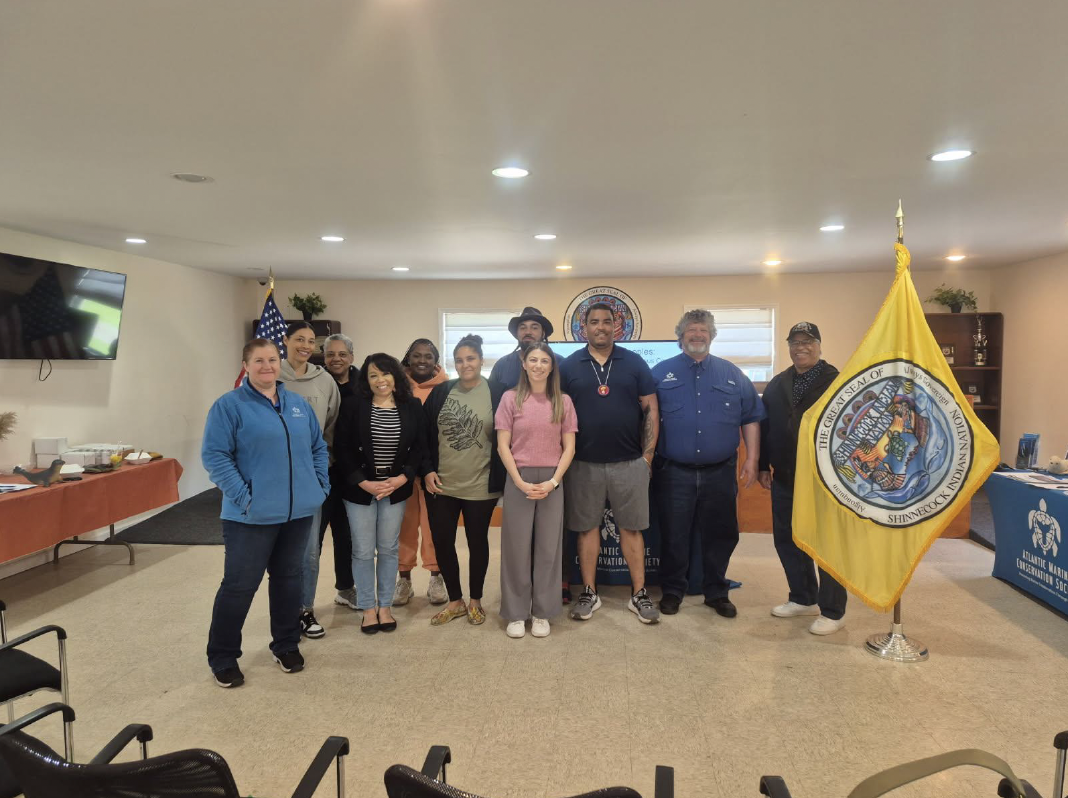
Waters to Peoples: Community Meeting
We co-hosted two more indigenous community meetings focused on protecting the marine life of Long Island Sound. In partnership with The Metoac Indigenous Collective and Atlantic Marine Conservation Society, this event focused on bridging the gap between science and traditional knowledge to protect Long Island Sound. It was great to learn about Indigenous knowledge systems and tribal cultural practices, and how relationship-building between communities and scientists strengthens conservation efforts. Thanks to all who participated.
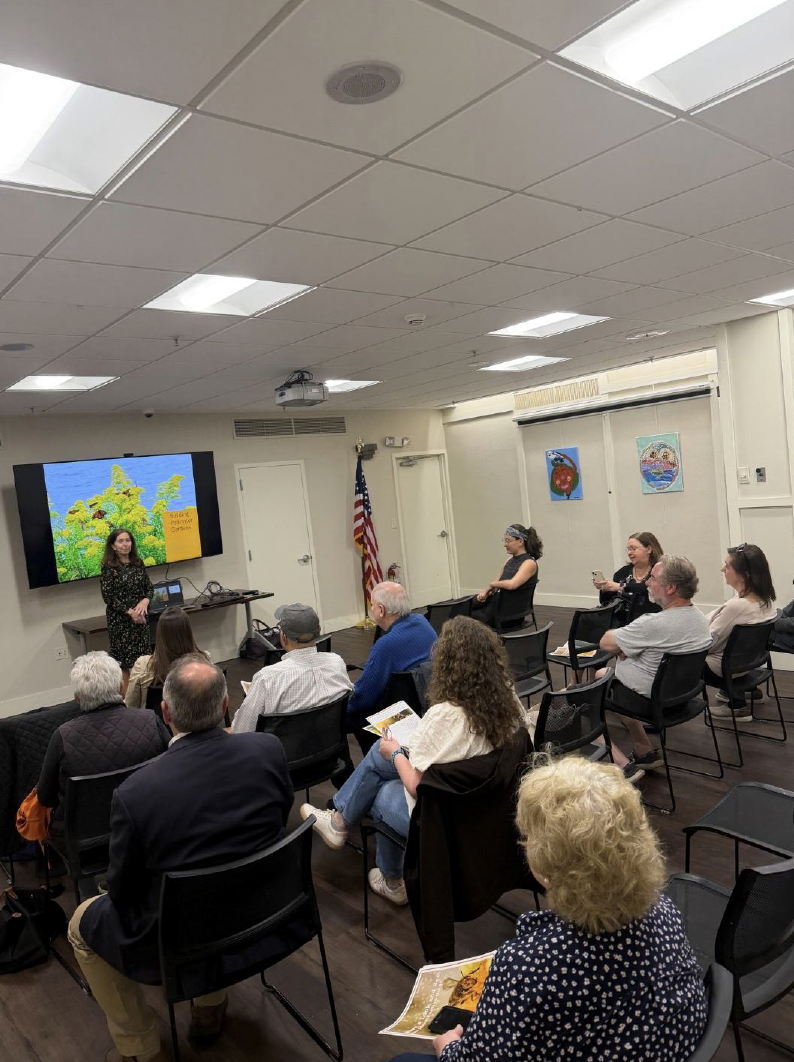
Upcoming: Planting a Patchogue Pollinator Garden
We are partnering with the Village of Patchogue to design a new pollinator garden, which will help protect our pollinators while reducing polluted stormwater runoff and beautifying the area. We held a community meeting in April to encourage residents to BEE part of the vision! If you live in Patchogue and want to get involved in the planting event on May 29th and 30th, sign up for more information here.
SOURCE:
March 12, 2026
More than 200 middle and high school students from across Long Island gathered at Stony Brook University for the 2026 Long Island Youth Climate Summit, an event designed to motivate and empower the next generation of climate leaders.
Held on March 10 in the Student Activities Center Ballroom, the summit brought together students from 13 schools across Nassau and Suffolk Counties for presentations, panels and sessions focused on climate science, activism, careers and solutions.
The event was hosted by Students for Climate Action and Renewable Energy Long Island, two local nonprofit organizations that promote clean and sustainable energy use across the region, and supported by partners including Stony Brook Workforce Development and Collaborative for the Earth (C4E).’
Melissa Parrott, executive director of Renewable Energy Long Island, welcomed students and addressed the purpose of the event.
“Our theme of the day is climate optimism, and we have a wonderful guest speaker that’s going to really motivate and change the way we think,” Parrott said. She introduced Adrienne Esposito, executive director and co-founder of Citizens Campaign for the Environment, who opened the summit with a talk about activism and the growing problem of misinformation surrounding environmental issues. “By being here, you are also acting as activists,” Esposito told the audience. “What does that mean? Activism gets a bad rap, but it simply means someone who desires change, and that is a good thing.”
Esposito encouraged students to recognize the power of participation and civic engagement.
“You matter. Your voice matters,” she said. “If you ever have a chance to go to a community meeting or a public meeting, even if you’re not the type of person who wants to stand up and speak, that’s fine. Just show up. Just being there in numbers causes elected officials to take notice that people care.
She also urged students to be aware of misinformation, especially on social media.
“Reading it doesn’t mean it’s true,” Esposito said. “Facebook is not a belief system. It’s just a social media tool. It’s really hard right now to fight climate change. But you are the generation we’re fighting for.”
Throughout the morning, students heard from advocates, researchers and industry leaders about the challenges of climate change and the many ways young people can become involved in solutions.
The keynote address was delivered by Heather White, an author, environmental policy expert and founder of One Green Thing, an organization focused on addressing climate anxiety through everyday action.
“Hope and joy are not naive,” White said. “They are defiant. Because we are the ones that are going to get us through this. No one is coming to save us. It’s up to all of us.”
White spoke about the emotional toll climate change can take on young people, a phenomenon often called eco anxiety, the title of White’s book on the topic.
“The American Psychological Association defines this as a chronic fear of environmental doom,” she said. “And in my view, eco anxiety is just a generalized anxiety about the future that my generation is leading you all and the future that you’re leading the next generation.
To help students feel empowered rather than overwhelmed, White introduced a concept she calls a “service superpower,” encouraging individuals to identify the strengths they bring to climate action.
“The fact is, you do matter, because every single one of us are culture change agents,” White said. “You are influential in your family, in your community, in your schools.”
Students then participated in an exercise to identify their own “superpowers,” and joined breakout groups with those who share their superpower to discuss how they could apply their strengths to environmental advocacy community engagement.
Suffolk County Executive Ed Romaine spoke to students about issues critical to the Long Island area, including solar energy, the removal of garbage off Long Island and railroad infrastructure.
The summit also highlighted career opportunities in climate and clean energy fields through a panel discussion featuring industry leaders, advocates and educators.
Chad Marvin of the Long Island Clean Energy Hub encouraged students to begin building experience early.
“When you get to the point when you come out of college, if you’re going to pursue a four-year degree, you are looking at job descriptions that are already requiring X years of experience, and you can fulfill that through the opportunities that are available for youth, which are volunteering and internships,” Marvin said.
Caroline Grattan of Applied Energy Services advised students not to become overwhelmed by the number of career options available.
“So many options are ahead of you, but if you have a bunch, just go with it, explore your options and you’ll figure it out,” she said.
Ryan Stanton of the Long Island Federation of Labor emphasized the importance of growth and learning through new experiences.
“Look at the New York State Department of Labor website for apprenticeships for unions and be coachable,” Stanton said. “Stay humble and put yourself in spaces and places that make you uncomfortable.”
Sydney LeGuillow of the Haugland Group encouraged students to follow their interests.
“Stick to your passions but don’t put too much pressure on yourself,” she said. “That will come over time. Just pursue what you’re passionate about.”
Adam Charboneau, lecturer in Stony Brook’s School of Marine and Atmospheric Sciences, offered more general guidance.
“I say that to slow down, enjoy the moments and see the world,” Charboneau said. “Do it as a child would. It’s a set of gifts. Don’t get over-transactionary or over-transactional.”
Parrott emphasized the importance of collective action.
“This has been such an opportunity to show students that there’s a way forward,” she said. “It could be through education, it could be through passion, it could be through motivation that they’re not alone.”
Parrott also reminded students that the work ahead will require commitment and collaboration.
“There’s a lot of work to do,” added Parrott. “It’s going to be hard, but we can do it.”
— Beth Squire
“Forever chemicals” known as PFAS — cancer-causing pollutants already found in Long Island groundwater — have been detected in vegetables purchased from farm stands across the North and South forks, according to a new study by Stony Brook University.