
State officials plan to boost funding for the Clean Vessel Assistance Program, a grant initiative that helps marinas install and upgrade boat pump-out stations that reduce water pollution.

The Environmental Protection Agency has come under fire for staff firings, climate and deregulation controversies, but Administrator Lee Zeldin, who is from Long Island, returned to his home turf Friday to spread the word on what is right with the EPA.
On May 14, the Farmingdale-based Citizens Campaign for the Environment (CCE) released a report of Long Island Sound water quality restoration projects it would like to see funded through the New York State Environmental Bond Act. The list was composed following meetings with village, town, county, and state representatives from across Long Island and shared digitally following a press conference at Northport Yacht Club.
Last summer, more than a hundred and fifty staff members at the Environmental Protection Agency sent a letter to the agency’s head, Lee Zeldin, outlining their concerns about his leadership. Topping the list was Zeldin’s naked partisanship. The administrator often used his official communications to trash Democrats. This “politicized messaging,” the letter said, was undermining trust in the agency. So, too, were Zeldin’s gutting of the E.P.A.’s research division and his tendency to ignore the findings of its scientists. The missive noted that it reflected the staffers’ personal, rather than professional, opinions, and had been written on their own time. It ended by urging Zeldin to “correct course.”
Long Island waters are threatened by runoff from hundreds of thousands of cesspools, harmful algae and even flesh-eating bacteria, but opportunities for cleanup are "unprecedented," a prominent ecologist will tell residents, advocates and elected officials in an address Friday.
Stony Brook University Professor Christopher Gobler, whose laboratory monitors water quality across the region, will host the annual State of the Bays symposium at the Stony Brook Southampton Avram Theater on Friday at 7 p.m. He gave a preview at a news conference Tuesday in Riverhead.
WASHINGTON — As a four-term congressman, Republican Lee Zeldin played a key role in the yearslong bipartisan push to save Plum Island, off Long Island’s North Fork, from potential commercial development. He helped secure funding for clean water projects in his Suffolk district. And he spoke out against a 2018 proposal to permit offshore drilling in the Atlantic Ocean.
Improved wastewater infrastructure and healthy shellfish populations are the keys to improving the water quality of Stony Brook Harbor. On Tuesday, Feb. 3, environmental activists and scientists gathered at the Stony Brook Yacht Club for a water quality forum, specifically focusing on Stony Brook Harbor.
Endowed Chair of Coastal Ecology and Conservation and Distinguished Professor at Stony Brook University’s School of Marine and Atmospheric Sciences Christopher J. Gobler spent the last two years monitoring water quality and shellfish populations in locations throughout the Stony Brook Harbor watershed. “We wanted to understand, what is controlling the growth of algae in Stony Brook Harbor?” he said.
Long Island’s drinking water supply is solely dependent on aquifers. Sarah Meyland, a retired professor at the New York Institute of Technology, spoke about the impacts of chronic water depletion on the region’s water supply.
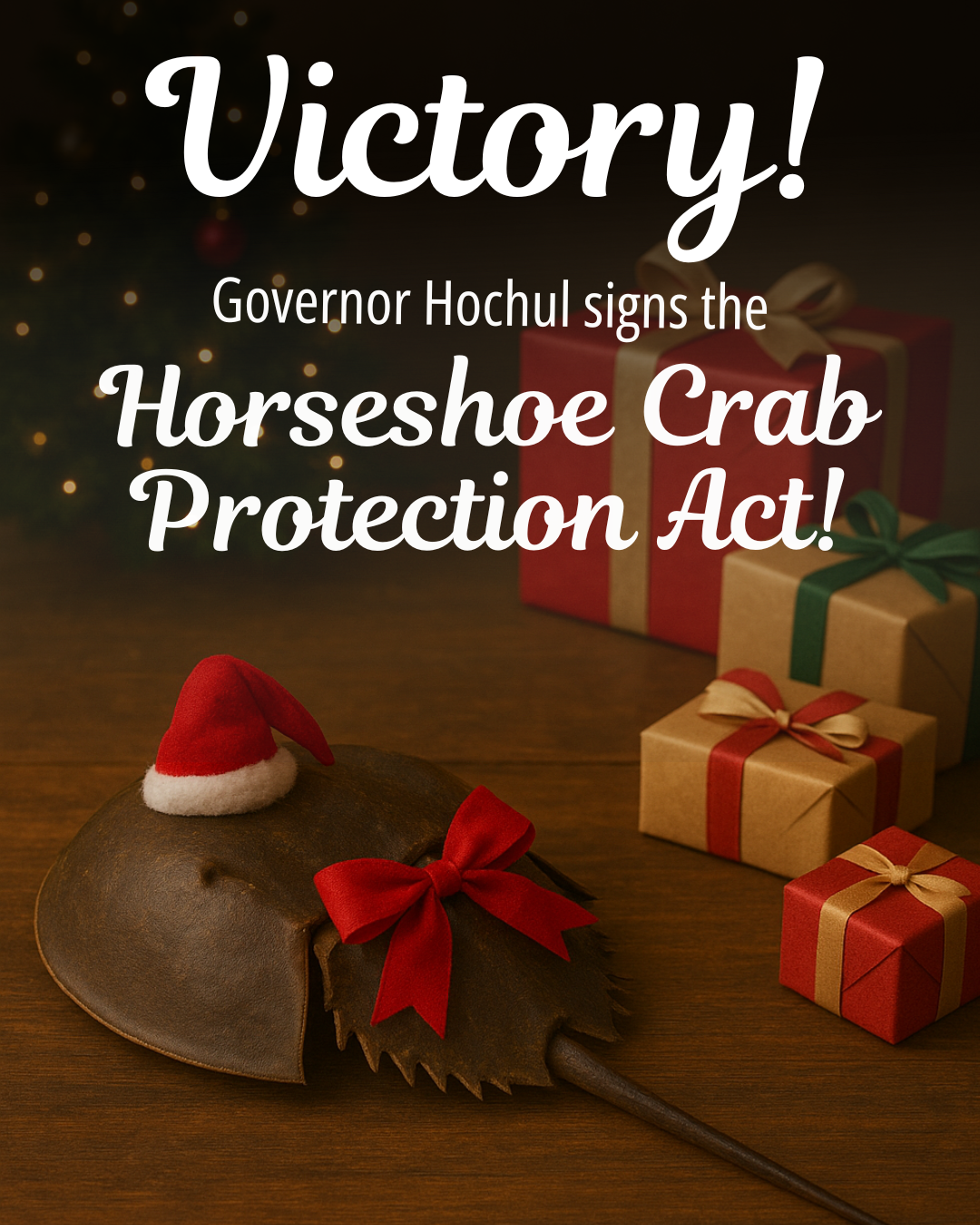
Gov. Kathy Hochul yesterday signed the Horseshoe Crab Protection Act, legislation that will phase out the taking of horseshoe crabs from New York waters for commercial and biomedical purposes over a three-year transition period, with a full prohibition taking effect in 2029, according to the bill’s lead Assembly sponsor, Deborah Glick.
Low-oxygen areas in Long Island Sound dropped last summer to the smallest footprint recorded in nearly 40 years, according to data from Connecticut’s Department of Energy and Environmental Protection.
"This is great news," said Adrienne Esposito, executive director of Citizens Campaign for the Environment in Farmingdale. "This is what happens when you have reliable funding, meaningful collaboration, strong public support, and good science — all working together."
For immediate release: December 20, 2025
For more information, contact:
Adrienne Esposito, Executive Director, 516-390-7150, aesposito@citizenscampaign.org
Albany, NY – Governor Hochul has signed the Horseshoe Crab Protection Act, which prohibits the taking of horseshoe crabs from state waters for commercial and biomedical uses. The bill will phase out taking horseshoe crabs over a three-year time frame and completely banning the antiquated practice by 2029. Horseshoe crabs are a keystone species in the food web that have walked the earth for 350 million years, but populations are in decline in the Northeast. This decline also threatens many species that depend on horseshoe crab eggs for food including several bird species and fish such as striped bass, weakfish, flounder and more. The Senate and Assembly passed legislation for the last two years that would prevent the taking of this crucial species for commercial or biomedical uses. The Governor vetoed the bill last year. This year, recent data shows further declines in horseshoe crab populations specifically in Long Island Sound. By signing the bill, New York has joined efforts with both New Jersey who banned harvesting in 2008 and Connecticut who banned it in 2024.
Adrienne Esposito, Executive Director for Citizens Campaign for the Environment, issued the following statement:
“Christmas came early for the Horseshoe Crabs! This is an amazing holiday gift, and Governor Hochul has given us a big reason to celebrate! Horseshoe crabs have walked the Earth since the time of the dinosaurs, and we want to make sure they don’t go extinct. The Horseshoe Crab Protection Act will prevent the taking of horseshoe crab for commercial and biomedical purposes, allowing horseshoe crab populations to rebound and New York to protect this historic species for future generations. This is an incredible holiday gift to our ecosystem and to the communities who love this important species. CCE applauds Governor Hochul, Senator Holyman and Assemblywoman Glick , for working together with environmental stakeholders, and scientific experts to ensure that the Horseshoe Crab Protection Act was signed into law this year.”
###
Will New York Governor Kathy Hochul sign or again veto a bill to protect horseshoe crabs that, by large majorities, passed again in the State Legislature earlier this year? Hochul vetoed the same bill last year.
On Oct 7, representatives from 15 environmentalist groups gathered in Northport Harbor to rally for the Horseshoe Crab Protection Act (S.4289/A.4997), which would ban the harvesting of horseshoe crabs in New York for commercial and biomedical use. A study released last month, authored by Dr. Rebha Raviraj from Maritime Aquarime at Norwalk, showed a decrease of 2-9% in horseshoe crab populations in the Long Island Sound. At the event, Dr. Raviraj described the losses across the 46-year study as “very significant,” linking them to habitat loss, over-harvesting, insufficient management practices, and climate change.
An effort is afoot for the second year in a row to get New York Governor Kathy Hochul to sign a bill banning the harvesting of horseshoe crabs for bait and biomedical purposes.