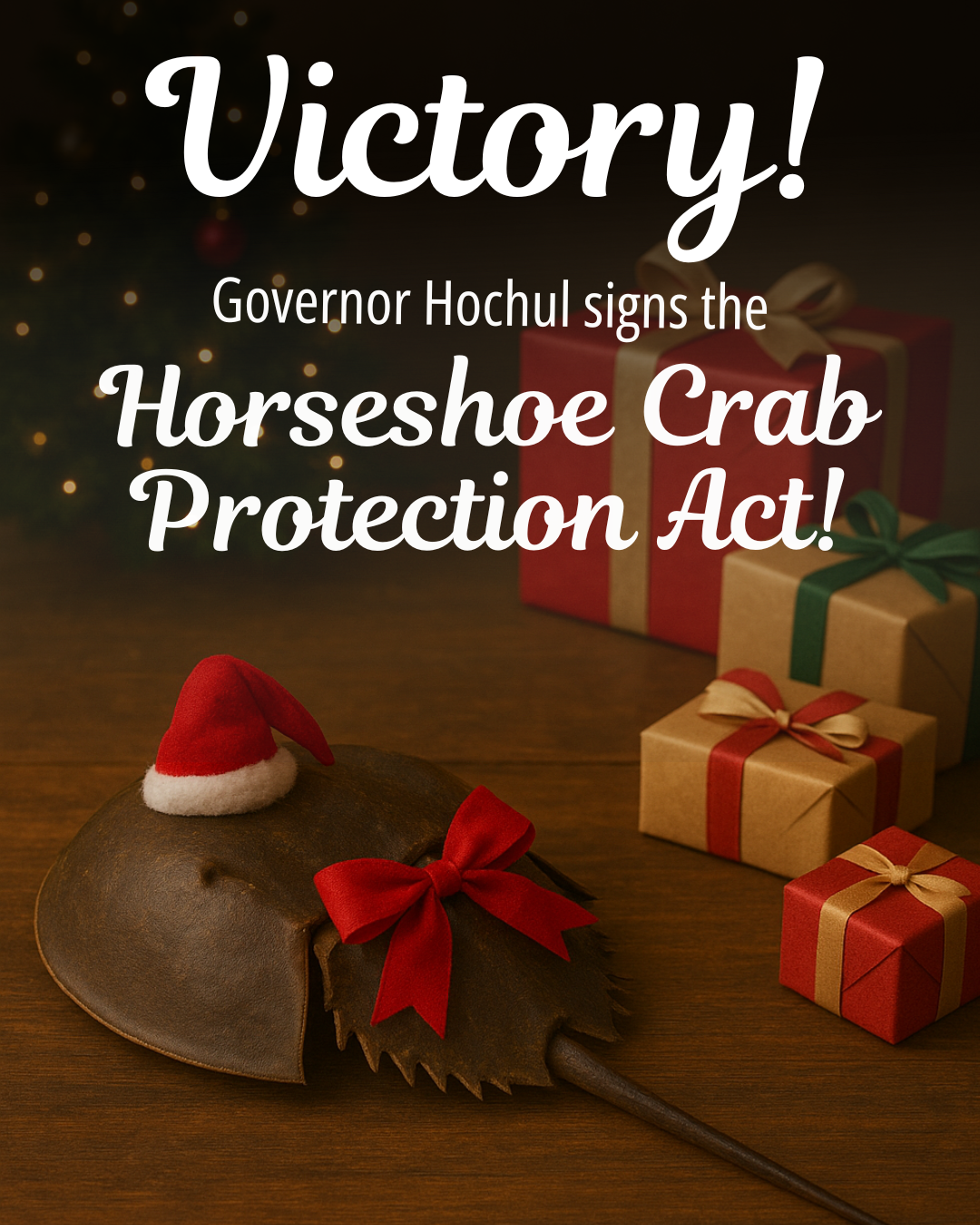
horseshoe crabs

Environmental Advocates Celebrate Passage Of Horseshoe Crab Protection Legislation

Environmental Advocates Celebrate Passage Of Horseshoe Crab Protection Legislation

NEW YORK — Environmental advocates are rejoicing after news that Governor Kathy Hochul has signed the Horseshoe Crab Protection Act, which will phase out harvesting horseshoe crabs from New York waters. 

The Horseshoe Crab Protection Act prohibits the taking of horseshoe crabs from state waters for commercial and biomedical uses, environmental advocates said.

Christmas Comes Early for Horseshoe Crabs! Governor Hochul Signs Landmark Legislation to Protect Horseshoe Crabs


CCE applauds Governor Hochul for signing the Horseshoe Crab Protection Act which will phase out harvesting horseshoe crabs from New York waters.

For immediate release: December 20, 2025
For more information, contact:
Adrienne Esposito, Executive Director, 516-390-7150, aesposito@citizenscampaign.org

Albany, NY – Governor Hochul has signed the Horseshoe Crab Protection Act, which prohibits the taking of horseshoe crabs from state waters for commercial and biomedical uses.  The bill will phase out taking horseshoe crabs over a three-year time frame and completely banning the antiquated practice by 2029.  Horseshoe crabs are a keystone species in the food web that have walked the earth for 350 million years, but populations are in decline in the Northeast. This decline also threatens many species that depend on horseshoe crab eggs for food including several bird species and fish such as striped bass, weakfish, flounder and more.   The Senate and Assembly passed legislation for the last two years that would prevent the taking of this crucial species for commercial or biomedical uses. The Governor vetoed the bill last year. This year, recent data shows further declines in horseshoe crab populations specifically in Long Island Sound.  By signing the bill, New York has joined efforts with both New Jersey who banned harvesting in 2008 and Connecticut who banned it in 2024. 

Adrienne Esposito, Executive Director for Citizens Campaign for the Environment, issued the following statement:
“Christmas came early for the Horseshoe Crabs! This is an amazing holiday gift, and Governor Hochul has given us a big reason to celebrate! Horseshoe crabs have walked the Earth since the time of the dinosaurs, and we want to make sure they don’t go extinct. The Horseshoe Crab Protection Act will prevent the taking of horseshoe crab for commercial and biomedical purposes, allowing horseshoe crab populations to rebound and New York to protect this historic species for future generations. This is an incredible holiday gift to our ecosystem and to the communities who love this important species.   CCE applauds Governor Hochul, Senator Holyman and Assemblywoman Glick , for working together with environmental stakeholders, and scientific experts to ensure that the Horseshoe Crab Protection Act was signed into law this year.”

###

Long Islanders Call on Gov. Hochul to Sign the Horseshoe Crab Protection Bill into Law

Long Islanders Call on Gov. Hochul to Sign the Horseshoe Crab Protection Bill into Law

Will New York Governor Kathy Hochul sign or again veto a bill to protect horseshoe crabs that, by large majorities, passed again in the State Legislature earlier this year? Hochul vetoed the same bill last year.

Don’t be crabby, environmental groups tell Hochul

Don’t be crabby, environmental groups tell Hochul

Northport Harbor was the backdrop for a press conference on Tuesday, Oct. 7, at which a coalition of environmental groups asked Gov. Kathy Hochul to sign legislation to protect the horseshoe crab in New York State. 

Environmentalists rally for Horseshoe Crab Protection Act at Northport Harbor

Environmentalists rally for Horseshoe Crab Protection Act at Northport Harbor

On Oct 7, representatives from 15 environmentalist groups gathered in Northport Harbor to rally for the Horseshoe Crab Protection Act (S.4289/A.4997), which would ban the harvesting of horseshoe crabs in New York for commercial and biomedical use. A study released last month, authored by Dr. Rebha Raviraj from Maritime Aquarime at Norwalk, showed a decrease of 2-9% in horseshoe crab populations in the Long Island Sound. At the event, Dr. Raviraj described the losses across the 46-year study as “very significant,” linking them to habitat loss, over-harvesting, insufficient management practices, and climate change.

Advocates urge Gov. Hochul to sign bill to save horseshoe crabs

Advocates urge Gov. Hochul to sign bill to save horseshoe crabs

Environmentalists are calling on New York state lawmakers to save the horseshoe crab.

Advocates rallied in Northport on Tuesday to urge Gov. Kathy Hochul to sign the “Horseshoe Crab Protection Act,” which would ban taking the animals from state waters for commercial or medical use.

CCE Director Esposito discusses environment and health at PJS-Terryville Civic meeting

CCE Director Esposito discusses environment and health at PJS-Terryville Civic meeting

The June 24 Port Jefferson Station-Terryville Civic Association meeting at Comsewogue Library saw Adrienne Esposito, the executive director for the Suffolk based CCE (Citizens Campaign for the Environment), featured as a special guest. Esposito touched on a number of topics related to health, the environment and local infrastructure and in particular advocated for three bills in the state senate and assembly.

Legislature again passes ban on harvesting of horseshoe crabs, after 2024 Hochul veto

Legislature again passes ban on harvesting of horseshoe crabs, after 2024 Hochul veto

ALBANY — State legislators have made another run at prohibiting the harvesting of horseshoe crabs, hoping a bill they approved this week won’t be quashed by a veto.

The State Senate gave final approval late Wednesday to a bill that bans harvest of horseshoe crabs for use as bait or for biomedical purposes. The Assembly passed it a week earlier.

The 2025 Trailblazers in Clean Energy

The 2025 Trailblazers in Clean Energy

Adrienne Esposito, the founder and longtime leader of Citizens Campaign for the Environment, has been launching new coalitions to further her environmental cause. One is Wind Works New York, whose diverse members are transitioning from fossil fuels to renewable energy. Another is the New York Clean Water Coalition, made up of water suppliers, wastewater treatment operators and environmental groups advocating for funding to upgrade sewage and drinking water infrastructure. Late last year, Esposito criticized the governor’s veto of the state Horseshoe Crab Protection Act, arguing that the species is subject to local extinction.

30,000 gallons of sewage discharged into Port Jefferson Harbor

30,000 gallons of sewage discharged into Port Jefferson Harbor

On the morning of April 14, an approximate total of 30,000 gallons of partially treated sewage was discharged into Port Jefferson Harbor over the course of two hours. According to the Suffolk County Department of Public Works, the discharge was caused by an electrical malfunction on a ultraviolet disinfection unit.  Upon identifying the problem, the plant ran the effluent through a second UV system, while they repaired and tested the first, then returned to routine operations. While the New York State Department of Environmental Conservation confirmed that the plant is now operating normally, but there are still health concerns. 

Health officials issue warning after Long Island sewage leak

Health officials issue warning after Long Island sewage leak

Keep children and pets away from the area, officials say. If contact does occur, rinse off the affected area with clean water immediately

Long Island residents living near Port Jefferson Harbor were warned by officials to stay away from the water, and to not even have dogs walk along the shore line. That’s because of a huge sewage spill into the harbor meant high levels of bacteria and viruses were floating around. NBC New York’s Pei-Sze Cheng reports.

Long Island health officials issue warning after sewage leak in Port Jefferson Harbor

Long Island health officials issue warning after sewage leak in Port Jefferson Harbor

A two-hour electrical malfunction led to a sewage spill in Port Jefferson Harbor. 

Thirty thousand gallons of partially treated sewage was discharged from its plant, the Department of Environmental Conservation said. The problem was a partial malfunction of the electrical sewage ultraviolet disinfection system.   

Environmentalists Outraged Over Hochul's Horseshoe Crab Bill Veto

Environmentalists Outraged Over Hochul's Horseshoe Crab Bill Veto

"While this bill is well-intentioned, the management of marine species is better left to the experts at DEC." — Gov. Kathy Hochul.

NEW YORK— Environmentalists are outraged over Gov. Kathy Hochul's recent decision to veto the Horseshoe Crab Protection Act, which prohibits the taking of horseshoe crabs from New York waters. The legislation would have allowed the populations to recover and ensured the survival of the important species, advocated said.

Hochul Vetoes Horseshoe Crab Harvest Ban

Hochul Vetoes Horseshoe Crab Harvest Ban

New York Governor Kathy Hochul has vetoed a bill that would have banned the harvest of horseshoe crabs for bait or biomedical research, saying in her veto statement Dec. 13 that she believes the management of marine species “is better left to the experts” at the New York State Department of Environmental Conservation. 

Horseshoe Crabs Left on the Chopping Block by Governor Hochul

Governor Hochul gives horseshoe crabs the axe by vetoing the Horseshoe Crab Protection Act. Advocates are alarmed with the Governor’s decision to leave this keystone species susceptible to local extinction.

For immediate release: December 15, 2024

For more information, contact: Adrienne Esposito, Executive Director: 516-390-7150, aesposito@citizenscampaign.org

Albany, NY –  Governor Kathy Hochul has vetoed the Horseshoe Crab Protection Act (S.3185A/A.10140), which was resoundingly passed by the NYS Legislature and has immense support from the public. This law would have prohibited the taking of horseshoe crabs for commercial and biomedical purposes in New York. A broad coalition of advocates and environmental organizations are disturbed by the Governor’s decision to veto this bill.

In response to the veto, Adrienne Esposito, Executive Director, Citizens Campaign for the Environment said:

“Governor Hochul didn’t just drop the ball; she dropped the axe by vetoing the Horseshoe Crab Protection Act. It’s unacceptable to allow the continued antiquated practice of chopping up horseshoe crabs so they can be used as bait by fisherman. Overharvesting has drastically depleted horseshoe crab populations, to the point where they now face local extinction. This archaic harvesting practice should have been left in the past, but with this veto, horseshoe crabs may be lost to history. We are appalled that Governor Hochul squandered a rare and special opportunity to save an ancient species from extinction. The Governor’s inaction is not only harmful to horseshoe crabs, but also to the many other species that rely on them, such as the Red Knot. Other states have already passed or are considering legislation to end the taking of horseshoe crabs, but New York has repeatedly failed to implement any meaningful protections. We are truly saddened that we are now more likely to see horseshoe crabs in museums than on our shores.”

Horseshoe Crabs have existed for over 350 million years, having shared the planet with the dinosaurs. Horseshoe crabs act as a keystone species in the food web, their eggs are the single most important food source for millions of migrating shorebirds, including threatened birds, such as the Red Knot. As horseshoe crab populations have drastically dropped, so has the Red Knot’s. Experts predict the Red Knot may become extinct unless action is taken to protect horseshoe crabs. Sharks, sportfish, sea turtles, and other species also feed on horseshoe crabs, making them critical to the food web and a diverse ecosystem. 

According to the Atlantic States Marine Fisheries Commission, horseshoe crab populations have been in decline for at least 15 years. This is largely due to harvesting by commercial fishermen who chop up the crabs and use them as bait for eel and conch. Horseshoe crabs are slow to mature and therefore very susceptible to harvesting impacts. Alternative eel and conch bait are in development to reduce the exploitation of horseshoe crabs while satisfying the needs of fishermen.

Horseshoe crab’s blue blood is used by pharmaceutical and medical manufacturers to test products for the presence of bacterial substances known as endotoxins.  However, New York has not issued permits for biomedical harvesting of horseshoe crabs in over 10 years. Now there are synthetic alternatives that are widely available and are an effective replacement for the blue blood of horseshoe crabs.

Over 40,000 letters, post cards, and emails from members of the public have been sent to the Governor in support of the Horseshoe Crab Protection Act and yet, the Governor ignored all of them. Connecticut has already banned the taking of horseshoe crabs and other states are considering similar action which may drive increased harvesting in New York’s waters. The Horseshoe Crab Protection Act (S.3185A/A.10140) would have prohibited that taking of horseshoe crabs for commercial and biomedical purposes and would have protected this vulnerable species and the many other species who rely on them.

Jane Goodall advocates for New York’s horseshoe crabs as time runs out on protection bill

Jane Goodall advocates for New York’s horseshoe crabs as time runs out on protection bill

Legendary conservationist Jane Goodall added her voice to those asking Gov. Kathy Hochul (D) to sign a bill that would prevent the harvest of horseshoe crabs in New York waters for biomedical or commercial fishing purposes.

PUSHING HOCHUL TO PROTECT HORSESHOE CRABS

PUSHING HOCHUL TO PROTECT HORSESHOE CRABS

The New York State Legislature passed a bill last June banning the harvesting of horseshoe crabs for bait and biomedical purposes, and environmental groups are pressuring Governor Kathy Hochul to sign the bill before the end of the year.