
A public advocacy group created a map showing how many water pipes are lead or may be made of lead.
New information is raising concerns about lead in Hudson Valley water systems.

Experts warn New York could face energy shortages as early as 2027.
Offshore wind offers clean, reliable power and price stability.
South Fork Wind Farm already powers 70,000 Long Island homes.
Upgraded transmission and new wind projects are urgently needed.
This fall, New Yorkers across the state showed up and spoke up to demand clean, affordable, reliable, safe and healthy energy infrastructure during the state’s energy plan hearings. Tragically, the Trump administration is wreaking havoc on our nation’s clean energy progress, making it more important than ever for New York to step up and lead the way to the sustainable, resilient system we need. Right now, we’re not on track.
New York State Department of Environmental Conservation (DEC) Commissioner Amanda Lefton today announced the release of the finalized Long Island Watershed Action Agenda (PDF). The Action Agenda is a clear-cut blueprint for water quality improvements, aquatic habitat conservation, groundwater protection, and the public engagement necessary to ensure success for the surface, coastal, and ground waters of Nassau and Suffolk counties.
On Oct 7, representatives from 15 environmentalist groups gathered in Northport Harbor to rally for the Horseshoe Crab Protection Act (S.4289/A.4997), which would ban the harvesting of horseshoe crabs in New York for commercial and biomedical use. A study released last month, authored by Dr. Rebha Raviraj from Maritime Aquarime at Norwalk, showed a decrease of 2-9% in horseshoe crab populations in the Long Island Sound. At the event, Dr. Raviraj described the losses across the 46-year study as “very significant,” linking them to habitat loss, over-harvesting, insufficient management practices, and climate change.
An effort is afoot for the second year in a row to get New York Governor Kathy Hochul to sign a bill banning the harvesting of horseshoe crabs for bait and biomedical purposes.
On Sept. 29, a mix of grassroots organizers, student activists, utility workers, elected officials, and environmental professionals voiced varying priorities at the New York State draft energy plan hearing at Stony Brook University. The university saw multiple outdoor rallies in addition to 2 ½ hours of public comments on the 15-year plan, with concerns covering jobs, affordability, environmental safety, and more.

Earlier this year, the U.S. Environmental Protection Agency (EPA) indicated that they intend to weaken the first-ever federal drinking water standards for dangerous PFAS chemicals. EPA intends to delay implementation of drinking water standards for two PFAS chemicals (PFOA & PFOS), while completely scrapping protections for four others (PFHxS, PFNA, GenX, PFBS). Rolling back these standards would put at least 1.3 million New Yorkers at risk to higher levels of dangerous PFAS chemicals in their drinking water!
Regardless of what the federal government does, Governor Hochul has the authority to maintain strong limits on PFAS in drinking water and protect the health of all New Yorkers—we need her to act!
Exposure to PFAS can lead to higher rates of kidney and testicular cancer, higher cholesterol levels, thyroid problems, adverse developmental effects and decreased immune response in children, and other serious health impacts.
New York State has authority to enact state regulations that will provide strong limits on PFAS in drinking water. Email Governor Hochul today and urge her to ensure New Yorker’s water is protected from dangerous PFAS chemicals!
Sincerely,
All of us at CCE

Help CCE build on our success, and support our campaigns to protect public health and the environment in NY and CT.
Make a contribution today.

Urging Governor Hochul to Save the Horseshoe Crab—Time is Running Out!
Horseshoe crabs have existed for over 350 million years, having shared this planet with the dinosaurs. Sadly, the species is now vulnerable to local extinction unless action is taken soon. In order to save the horseshoe crab and the species that depend upon them, Connecticut passed a ban on harvesting them in 2023. This year, the New York State Legislature passed a bill to ban harvesting horseshoe crabs. Governor Hochul now has until the end of 2025 to decide whether to veto the bill or sign it into law. Email Governor Hochul today and urge her to sign this important bill into law!

Suffolk Legislature Honors CCE for 40 Years of Work
We were thrilled to be recognized by the Suffolk County Legislature for 40 years of safeguarding Suffolk County’s drinking and coastal waters and protecting our natural environment. A huge thank you to Legislator Steve Englebright for this incredible honor. We’re excited to continue this important work together!
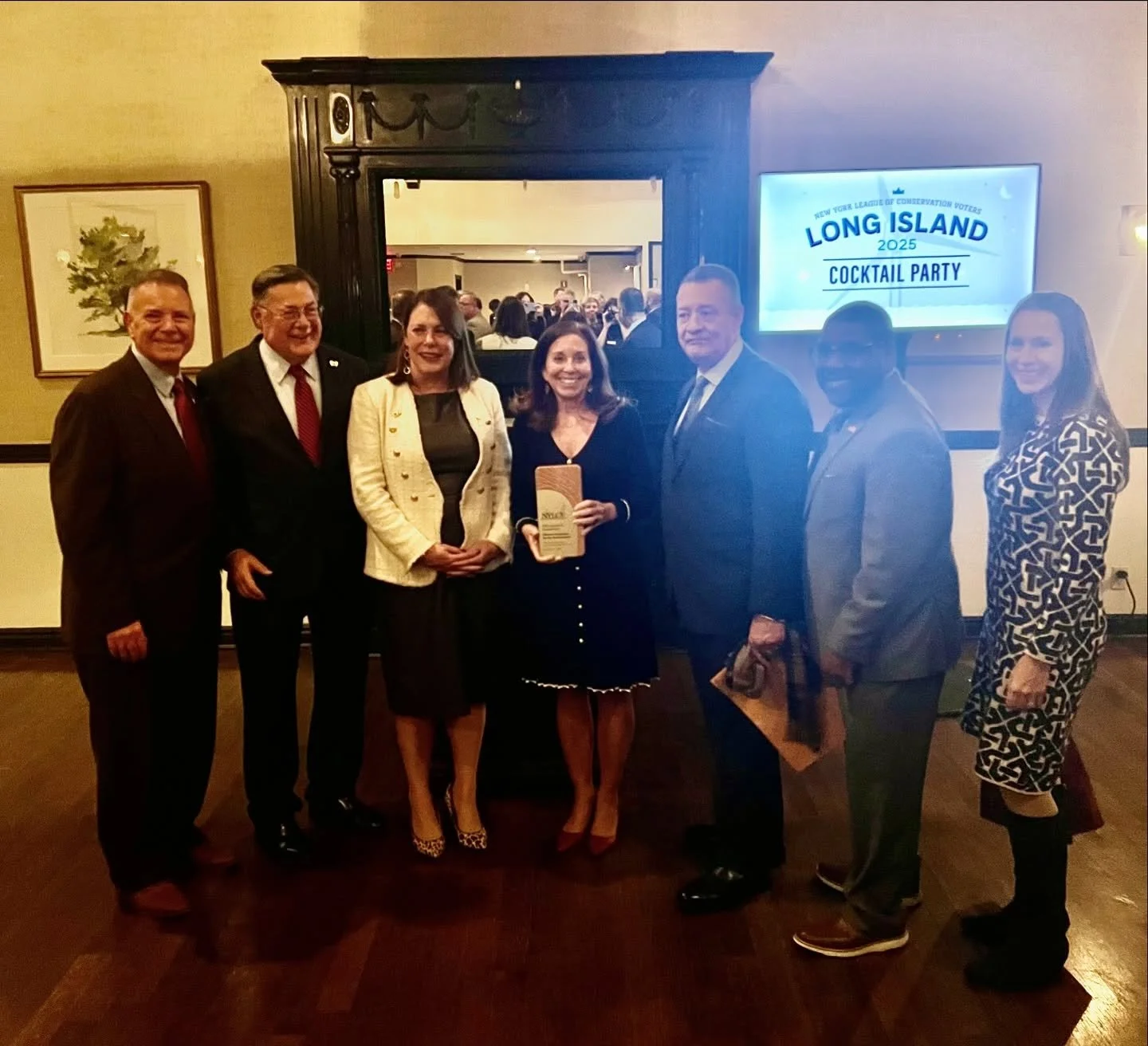
NYLCV Honors CCE
A sincere thank you to the New York League of Conservation Voters for recognizing us as the 2025 Education Fund Honoree at this year’s Long Island Cocktail Party. We are incredibly proud of our work educating the public on the benefits of offshore wind in our community and we are grateful for the recognition. We look forward to working together with our partners at NYLCV to transition away from dirty polluting fossil fuels and embrace renewable energy in NY!

Advocating for the Great Lakes in Washington, D.C.
In November, we traveled to D.C. with a team of environmental groups and student researchers to meet with members of New York’s Congressional Delegation (pictured above with Representative John Mannion). We explained the ongoing threats to the health of the lakes, ranging from legacy toxic contamination, to sewage, to microplastics, and called on members of Congress to support efforts to protect and restore the health of our Great Lakes through reauthorization of the Great Lakes Restoration Initiative.

Fighting to Fund Clean Water Protection in New York
We joined NYS Senator Pete Harckham and our environmental partners in November to urge Governor Hochul to include $500 million for the Clean Water Infrastructure Act (CWIA) in the 2026 state budget. The CWIA program allows communities to upgrade sewers and septic systems, replace lead drinking water pipes, install treatment technology for emerging contaminants, protect source water, and more. Since 2017, New York has provided over $6 billion for this important program, which has provided significant results for New York’s environment and economy.

Learning about Whales & Sharks
Last month, we hosted a South Shore Estuary Reserve meeting featuring an excellent whale and shark panel discussion. We learned a lot from our speakers, Dr. Artie Kopelman from Coastal Research and Education Society of Long Island, Rob DiGiovanni from Atlantic Marine Conservation Society, Dr. Merry Camhi as our local shark expert, and Carl Lobue from The Nature Conservancy, who provided informative presentations and cultivated an engaging discussion on whale and shark conservation. Thank you to the Marine Nature Study Area in Oceanside for hosting us at their new educational facility and tour of the nature preserve!

Lunch and Learn: Success of South Fork Wind
It's officially been one year since South Fork Wind, America's first commercial-scale offshore wind farm, began its operations. To highlight its success, Orsted joined us and our Wind Works partners for a Lunch and Learn webinar followed by Q & A. This was a great opportunity to learn more about how the South Fork Wind Farm is powering 70,000 homes and strengthening our energy grid. If you missed it, you can check it out here.

Yes to Wind Economic Roundtable
As part of the #YesToWind National Offshore Wind Week of Action, we brought together industry leaders to highlight how offshore wind is powering economic growth, creating good-paying jobs, and strengthening New York’s clean energy supply chain. We had a fantastic panel discussion with the Long Island Federation of Labor, Haugland Group, Institute for Workforce Advancement, and Port of Coeymans Marine Terminal. You can watch a video of the event here.
Brookhaven officials have been ordered by state environmental authorities to prepare a landfill cleanup plan that could include closing the 51-year-old facility after an inspection earlier this year found elevated levels of so-called "forever chemicals" in a miles-long plume emanating from the dump.
No place could be more impacted than Nassau County by the EPA’s decision to postpone by two years the deadline for water utilities to comply with new federal water standards for PFAS until 2031.
These chemicals are dangerous, having been linked to a large number of illnesses – kidney cancer, testicular cancer, high cholesterol, immune suppression, thyroid disease, and pregnancy complications.
Attorney General Letitia James is right when she states: “Every New Yorker deserves clean, safe water.”
But it takes more than an assertion to make clean water happen. Fighting the pollution that continues to threaten the water we drink and area waterways that support wildlife and recreation takes leadership and aggressive measures from the state. It doesn’t look like we’re getting enough of either from New York’s Department of Environmental Conservation.
The Long Island South Shore Estuary Reserve, a sprawling 70-mile-long network of waterways vulnerable to environmental pressures, will receive a $2.4 million infusion of state funding.
The New York State Department of State, at a press conference at Tobay Beach Wednesday afternoon, said eight municipalities, nonprofits and agencies earned the awards through the South Shore Estuary Reserve Local Assistance Grant Program.
After the discovery of chemical drums at Bethpage Community Park last year, Oyster Bay officials worried about the presence of hexavalent chromium, a cancer-causing toxin, in the soil near the drums, federal court records show.
They were concerned by what they saw: yellow and green sludge, a sign of chromium contamination, according to a filing in the town's lawsuit against Northrop Grumman, which seeks to accelerate and widen the scope of the plan to clean up the 18-acre property Grumman Aerospace used as a toxic dumping grounds for decades.
In the most recent fiscal year, New York made more investments in water infrastructure than in any prior year.
Announcing the record spending Wednesday at Albany’s Corning Preserve, President and CEO of New York’s Environmental Facilities Corporation Maureen Coleman says nearly 330 projects were executed with financial assistance in the last fiscal year -- a 55 percent increase year-to-year.